
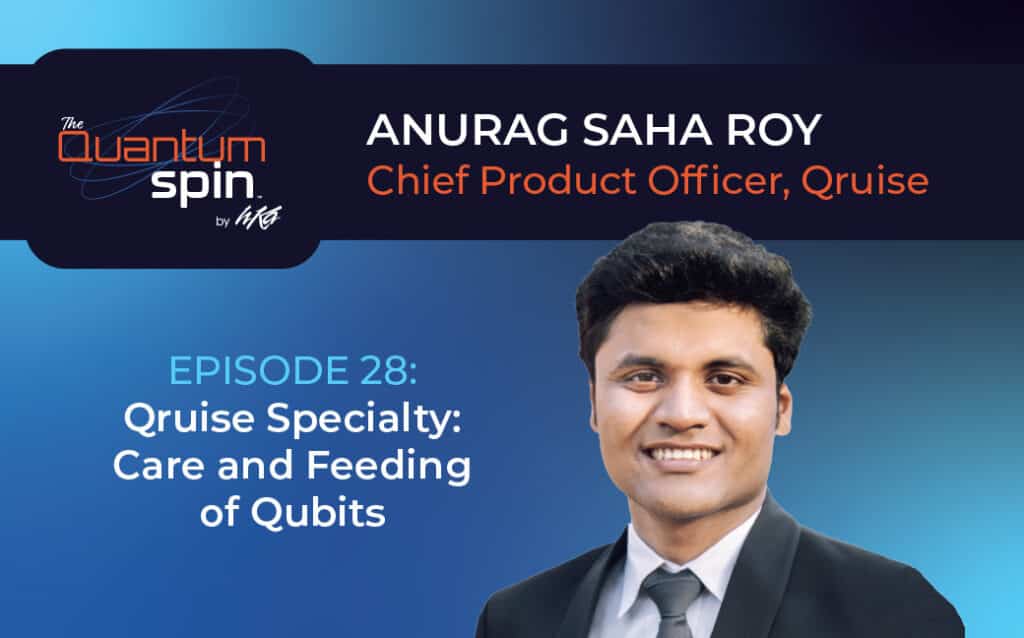
Qruise Specialty: Care and Feeding of Qubits
Overview
Anurag Saha Roy, Chief Product Officer of Qruise, found the perfect place to combine his two interests of physics and science: building hardware solutions for quantum computers. In this conversation with host Veronica Combs, Anurag describes the complexities of booting up a quantum computer and the necessity for continuous calibration. Qruise works with researchers and quantum hardware engineers to make this process quicker and more reliable. Anurag also explains the need for a broader community for quantum software development as well as what classical software engineers can contribute.
00:00 Introduction to Quantum Spin Season Four
00:29 Exploring Quantum Software with Anurag from Qruise
02:56 The Role of Digital Twins in Quantum Computing
11:25 Building a Quantum Software Developer Community
19:21 Future Prospects and Challenges in Quantum Computing
23:16 Conclusion and Farewell
Anurag Saha Roy is the Chief Product Officer at Qruise. He is an experienced engineer and entrepreneur with a background in machine learning and various quantum technology platforms. At Qruise, he leads a team of physicists and software engineers developing tools to automate and accelerate the development of quantum devices through the use of digital twins for faster and better calibration and characterization.
Transcript
[00:00:00] Veronica Combs: Hello, I’m Veronica Combs, and this is the Quantum Spin by HKA. For season four, we decided to do something a little different. In March, we attended the APS Global Physics Summit in Anaheim, California. We took advantage of this amazing event to talk to the leaders in academia, industry, as well as the creative folks who helped make the event such a compelling experience.
[00:00:23] I hope you enjoy these conversations that really reflect what’s happening in the industry right now.
[00:00:29] My conversation today is with Anurag, who is the Chief Product Officer of Qruise, and I have been wanting to talk to someone about quantum’s software development, so I’m so glad to have you with us today.
[00:00:40] Anurag SahaRoy: Hi, I’m Anurag and it’s really nice to be with Veronica today. I think I have heard a few of the episodes of the Quantum Spin podcast and I’m really glad to be here.
[00:00:48] Veronica Combs: Great. We talk a lot about qubits and hardware, but software is really the key to getting things done and Qruise helps to build software to make quantum computers perform better. So what does that mean to a general IT person who wants to do that?
[00:01:02] Anurag SahaRoy: So I think one big difference with quantum computers compared to traditional classical computers is that we are still in very early stages of these quantum computers, which means unlike your MacBook, which you can just open and it starts working, uh, quantum computers need a lot of housekeeping and babysitting basically, to get them to do what you want them to do, which means there’s a lot of scope for software to actually help with this whole housekeeping and babysitting process. so just like you have an operating system for your classical computer, you need something like an operating system for your quantum computer, so the equivalent of Windows or Linux or Mac OS, but for quantum computers and unfortunately because quantum computers are still in very early stages of development you have to do a lot of calibrations optimizations so that you can get all of the operations to perform exactly the way you want them to.
[00:01:52] And you have to keep doing them again and again. So it’s not just that you do them when you open it up the first time, but you do it maybe twice, thrice daily, and then every day you use the device. So we basically develop software that does this. So we develop software that helps with the optimization of these quantum computers to calibrate all of the different moving parts in this gigantic thing that you have and get them all working in sync so that you can get the end operations performing very smoothly.
[00:02:17] So that’s one part of this whole optimization game. Then the other, let’s say, interesting thing about quantum computers is that no matter what you hear in the news, it’s still very much at the stage that whatever we are developing, they’re essentially very advanced engineering prototypes. So they’re still prototypes, just that they’re very advanced prototypes, which means that even though we have devices in the cloud, we have devices that people are using,
[00:02:41] at the end of the day, what you really want to do with one of these devices is understand how to make a better device. So your goal is really, okay, this is my current prototype, but my vision is on a three-year, five-year timeline. How do I use this current device to understand how to make an even better device?
[00:02:58] And that’s also something that we do. We develop the software that helps scientists, engineers, and manufacturers understand how to improve from their current generation of quantum computers to the next generation ones.
[00:03:08] Veronica Combs: So they’re toddlers, basically. You can’t take your eyes off of them because they always need supervision.
[00:03:12] Anurag SahaRoy: Babysitting
[00:03:13] Veronica Combs: Yes. Babysitting. And I think digital twins I could really see the benefit of this. And I believe that you’re helping customers build digital twins of certain procedures or processes. So I’m curious about that.
[00:03:24] Anurag SahaRoy: I think so with digital twins one big challenge that often people have when working with digital twins for engineering, for science products is that most of the times they’re built either from first principles, in which case there is a problem that the first principles simplified understanding might not truly capture what is happening in reality.
[00:03:43] Other times they are built using something like neural networks where they’re completely black box. So you built up a digital twin by feeding it a lot of data, but then you no longer understand why the device is behaving the way it’s behaving. So you have these two extremes where either you have a simplified model where you understand everything, but it doesn’t reflect reality, or you have a very complicated model that reflects reality, but you don’t understand why it does what it does. We actually have developed digital twins that bridge this gap. So we develop digital twins using physics-based machine learning, which basically brings together the best of both worlds where you can have this physics-based first principle models, but then you can feed it a lot of data so that these models, these digital twins, accurately reflect what happens.
[00:04:26] On the real hardware. And we do this for quantum computers, for quantum sensors, and there are a few, let’s say, use cases or applications where you can use these digital twins. So of course they help a lot with optimizing the devices because you can try out many different protocols, many different tools on the digital twins to understand what works, and only then apply it to the real hardware because of course quantum computing hardware time is expensive.
[00:04:51] It’s precious. You don’t want to try out 10 different possibilities that you know might or might not work, and you can try those all out on the digital twin, find the best fitting one, and only use this optimal one on your real hardware. The second thing actually goes back to what I was talking about in the second part of my conversation in the previous answer,
[00:05:08] is that you want to understand how to build better quantum computers. So we use the digital twin for a lot of these tasks. What we do is we we use all this data that we get from the real quantum hardware by running experiments on them, feed them into the digital twin, and then our software has certain predictive machine learning algorithms that can tell the users that, okay, based on this physics-based digital twin that you have, and based on all the data that you have given me from your experiments.
[00:05:34] A, B, C, D are the different things that you should be working on to create a better quantum computer. So we provide scientists, engineers with this kind of predictive insights that these are the different things that you need to work on. For example, you need to, I don’t know, put your device in a more controlled environment where maybe the temperature variations are a lot less, or you need to design better control electronics, use more advanced converters, things like that.
[00:05:58] Veronica Combs: So the twin would say, this particular configuration causes a lot of noise. So instead of this design, use this or that. Exactly. Yeah, so you could solve, I don’t know, a good percentage or you could address, I guess I should say, a certain percentage of the problems before, like you said, you spend that expensive quantum computer time and um, so who are your customers?
[00:06:16] Who are you working with on all these projects?
[00:06:18] Anurag SahaRoy: As you might or might not have figured from what I’m describing the software is something that lives very close to the hardware. So unlike a lot of the, let’s say, quantum algorithms and quantum applications, software teams, software products that live higher up in the quantum computing stack where they liaison very closely with the end users, our software actually lives much lower in the stack, which means we liaison with scientists and engineers in the laboratory.
[00:06:42] So most of our users are primarily academic groups or startups or companies, and they all have the common trait that they’re developing. quantum computing hardware, quantum sensing hardware. Basically anybody who’s working in the field of designing, manufacturing, developing hardware for quantum technologies, they are our users.
[00:07:02] People developing superconducting qubits coming up with new architectures, developing large chips, identifying problems with these things. It has to be somebody who spends a lot of their time working with the hardware, and that’s where we bring value because we help them understand how software can help in this process to improve the hardware.
[00:07:18] Veronica Combs: It will be some time before that abstraction level gets higher. We’re really close to the device now, and so in, I don’t know, 10 years will be higher up that stack. Is that the way you think of it?
[00:07:30] Anurag SahaRoy: Yeah I think that will actually, again, something that we can look back on history to take, inspiration from, I think back in the fifties, sixties, we still had a lot of the computing done at the low level, which means.
[00:07:41] Even though we had operating systems, we still had operating systems back then we didn’t have something with the level of polish and abstraction that modern Mac OS or modern Windows has, or modern Linux has. So we’ll see something similar that only after five to 10 years that a lot of this optimization essentially becomes completely under the hood and the abstraction layer goes up and the users don’t need to deal with all of these complexities.
[00:08:03] Veronica Combs: So your background is in electrical engineering and machine learning. How did you arrive at Qruise?
[00:08:08] Anurag SahaRoy: That’s a very nice question because I think it’s always interesting because I started studying electrical engineering because I loved physics, I loved computer science, and I couldn’t decide on a major. So I was like, let’s do the one that has a significant overlap of both physics and computer science.
[00:08:24] So I ended up doing electrical engineering, did a lot of machine learning during my initial years. But I think it was as early as my freshman year that we had exposition codes on quantum computing where interested folks were taught the basics and I found that fascinating.
[00:08:38] So this was, I think back in 2012, so quite some time back. But, and this was also when quantum wasn’t cool, let’s say, or not part of the hype train yet. So it was quite nice because it was a very small community. And then I think from there, I just have spent almost a decade at this point being I think at all points in a handsome mix of academia and startups within the quantum technology space, and spent a lot of time doing cold atoms initially.
[00:09:06] And I think the other thing that led me to Qruise is that I spent a lot of time being a hardware guy, which means I felt a lot of the problems that I’m trying to solve today. So the first part of my career was almost entirely in quantum technology, quantum sensing hardware space primarily with cold atoms.
[00:09:22] Developing these experiments, developing these products, and I saw a lot of the challenges that everyday experimentalists face in the lab. And coming from a software and machine learning background, I could also see that, okay, these look like things that could be instantly solved. With software or at least addressed to a certain extent.
[00:09:39] And then I think back in 2020, 2021 when some of the professors that I was working with at that time started thinking about developing Qruise, it was a very natural fit for me to bring together both all of my experience in quantum technology, hardware space, but also my background in machine learning and software.
[00:09:56] And make something good out of it.
[00:09:57] Veronica Combs: Oh, very cool. Very cool. And you used some machine learning to think about climate change, right?
[00:10:02] Anurag SahaRoy: Yeah, so that was again, I think back in 2019 at this point already quite some time back to when I spent quite a bit of time using machine learning to help with weather forecasting, specifically forecasting wildfires.
[00:10:15] Because a big challenge is that, so we are in California, like I think California wildfires are one of the most well known wildfires,
[00:10:23] Veronica Combs: sadly. Yes. Sadly enough.
[00:10:24] Anurag SahaRoy: Exactly. But the thing is that wildfires are a lot more dampened than we hear about in the news. Like large swaths of the us large swaths of Southern Europe, large parts of Southeast Asia, they all experience wildfires.
[00:10:36] But we simply do not have the level of advanced prediction tools that, let’s say the West Coast currently has simply because of lack of resources, lack of attention, whatever it is. So I was working primarily with the European weather agencies to develop machine learning tools that could augment a lot of classical approaches to weather forecasting, wildfire forecasting, because a big challenge with the classical approaches is that they are very compute
[00:11:03] expensive, which means you need this really large supercomputers. And spend a lot of resources on them to get very good wildfire forecasting, which is often not possible for a lot of countries in the Global South. So I was primarily working on addressing these challenges and developing the solutions for users in Global South where we could tap into a lot more, maybe citizen science, a lot more artificial neural network based approaches to bring down the cost of compute necessary to make this very accurate wildfire forecasting.
[00:11:33] Veronica Combs: I think flooding forecasting is another really important application because if there’s anything scarier than fire, it’s probably flood. Yes. And we’re all dealing with that now because of climate change. Very cool. So I remember when I first talked to a person in charge of building a software developer community, and I thought, I didn’t know you had to do that.
[00:11:50] But then obviously it’s a key part of the community because if you don’t have people who can write the software, what are you gonna do with your hardware? So I’m curious about how you think about building that kind of community as part of Qruise or as part of the industry in general, but you’re working specifically at Qruise.
[00:12:04] Anurag SahaRoy: Yeah. I think one big transformation that happened in the software industry at the turn of the century was there was a proliferation of APIs and SDKs. So what are APIs and SDKs? APIs are application programming interfaces. SDKs are software development kits. Now very technical jargon, but let’s break it down.
[00:12:23] What they really mean is that at the turn of the century, we realized that there is a lot more value, both commercial value as well as just, user value, user proposition, and just end user advantages to be had by opening up your software as a platform and how to look at it is that you are no longer selling or making software that ends where you have finished building it, but no, you are developing software that somebody will develop on top of.
[00:12:49] And as soon as the software community the technology community realized that, okay, that just means that the kind of use cases, the kind of applications, the kind of benefit that my software can build or deliver is now infinite because it’s no longer tied to what I can think of, what I can develop, what I can build, but what the whole community, the whole world can build on top of my software.
[00:13:10] And I think this really was a turning point because this is when people started realizing that what you need to do is develop a community around your software product and not just have users, but have a community of people who look at your software product as a platform on top of which they don’t just get things done for themselves, but they actually develop tools that can probably help others as well.
[00:13:30] So I think, um, with the quantum computing industry, we are at this point where we are starting to reach the level of maturity where people can start developing software tools, software products on top of existing platforms. And at least for the quantum computing community, I think. The whole Qiskit stack did a lot for the community because it introduced the community at a very early stage when most of the community was just physicists and scientists who might not have been that exposed to the idea of APIs and SDKs and developer ecosystems.
[00:14:01] It introduced this concept of open source quantum computing stack on top of which people could develop their own applications. So I think it’s a lot of credit to be given to the IBM team for developing and having that vision. That mindset to build that stack. And I think that did us a lot of good, because two things happened.
[00:14:17] Firstly it educated physicists and scientists about this whole, developing software as a platform thing. But it also brought in a lot of career software engineers, career software professionals from outside the quantum computing industry into the industry. And this is happening a lot right now.
[00:14:31] And I think this is also something that I do a lot within Qruise within our community, is that we want a lot more of folks who have been doing software for 10 years, 20 years, 30 years, with zero quantum computing experience to come and join us in the community because at this point, quantum computing is in the engineering transformation stage.
[00:14:50] So a lot of the underlying science, underlying physics has been very well studied, very well understood. We need a lot more engineers and software developers to build the things out than to actually sit and study theoretical equations of quantum mechanics. So this is a perfect time for developing this ecosystem.
[00:15:06] And I think a few things go into developing software ecosystems and developer friendly ecosystems. I think community is actually very important because you need, and when I say community, I don’t just mean a group of people, more the whole vibe around the community you want a very welcoming group.
[00:15:23] You want people who do not gatekeep the industry, the development, the software, and again, I’m quite lucky that the quantum computing industry has generally not been like this. We do not gatekeep quantum computing resources. If anything. I think there’s a lot of very enthusiastic, encouraging folks are always
[00:15:40] evangelizing quantum computing that, yeah, you need to come and do this. It’s super easy, super cool. We need people. So I think that’s already one thing that we have going for the community, that we are a very open bunch of folks always asking people to come and join us. And then I think, the biggest thing after that, a lot of it are just more logistics that have a lot of resources for newcomers.
[00:16:01] Make sure there is adequate mentorship for young junior folks who are joining the community and have a lot of good interaction between big tech or the larger players in the ecosystem and more smaller shops, smaller open source groups. And then of course open source itself is also quite important for any developer community because even when there are a lot of closed source tools.
[00:16:23] Having a few open source tools helps because then you have always a very healthy development ecosystem between closed source proprietary tools and open source tools, and you can develop these kind of very nice platforms that I was talking about where you don’t just build software for yourself, but you build a platform on top of which everybody else can build software tools.
[00:16:41] Veronica Combs: And I think there’s so much experience and wisdom and insight in that community, right? Because you won’t know all the use cases as the Chief Product Officer of Qruise, but someone else has done, I don’t know, worked in a factory or programmed a computer to do something in telecom.
[00:16:56] So I think that the investment in community is really worth it, even if it’s hard to see initially. So is there anything that you’d like to see the industry do to help shape that community or support it or provide resources like you mentioned?
[00:17:07] Anurag SahaRoy: That’s a good question. I think again I always take inspiration from the classical computing community and I think there there are already quite a few
[00:17:16] established developer conferences that take place every year that bring together developers from very broad and diverse backgrounds which is just fantastic for exchanging ideas, understanding new things, just finding out completely unknown applications, unknown challenges, unknown experiences.
[00:17:34] I think we are still at the stage where we don’t have this kind of established conferences or gatherings. So that would be quite nice if we can, as a community, start having more of these quantum computing focused developer conferences. And I think the other thing is that because we are starting, we can also take a lot of inspiration from what went wrong, in the classical domain, so we can, have more inclusive conferences where we have conferences, not just
[00:17:58] somewhere in the US but also conferences all over the world because it’s not always possible for people from all over the world to travel to the US. Right, right. So just being a lot more inclusive and a lot more distributed and making sure that when we develop this developer community it is indeed a community for everyone
[00:18:14] by everyone. Yeah.
[00:18:15] Veronica Combs: Yes. I always encourage organizers to keep some kind of virtual option, right? Because like you said, travel is just impossible for some folks, but they do have an internet connection and a laptop, and they can contribute and learn,
[00:18:25] and I think when I started reading about all the subsystems that go into quantum hardware, it’s just so amazingly complex. And I think about lasers and electronics and there’s just so much. What does your team at Qruise have all that expertise?
[00:18:37] Anurag SahaRoy: We have to have that experience simply because of the
[00:18:40] nature of software that we develop. Fortunately for me that’s just fantastic because every day I log into work and I’m just so happy that I’m working with people with such diverse backgrounds. And they’re all fantastic, smart people with very advanced experience, advanced degrees, and a lot of really very specific and, a niche experience in very technical domains. So yeah we do have to have that. And frankly, like you were saying, like it’s amazing that quantum computers work when you look at all the moving parts that need to work together correctly at the same time to get this to work I think it’s fantastic.
[00:19:14] And it’s not just quantum computers. Even your, the fact that your smartphone can do what it can do, when you actually look at what everything is underneath that really thin device, you realize that modern technology is nothing short of magic. I think with quantum computers, simply because everything is still so big and not miniaturized, we actually get to see all of these moving parts.
[00:19:34] Mm-hmm. And all of the magic that happens behind the scenes.
[00:19:37] Veronica Combs: Right. Yes. So what is on your list of to-dos this year for Qruise as the Chief Products Officer?
[00:19:42] Are you working on new products or iterations of existing ones?
[00:19:46] Anurag SahaRoy: So we have two primary products, Qruise OS and Qruise ML. And these, again, let’s say, align at the very beginning, the two different applications that I was talking about. One is optimizing and calibrating your current hardware
[00:19:57] and the other is how do we identify how to improve the next generation of hardware. So we are releasing a lot of features for these two tools. A lot of interesting case studies with a lot of our partners and collaborators that should all be coming out in the coming months. We are also working and this actually goes back to the whole discussion regarding community and developer ecosystem.
[00:20:15] We are working very closely with other partners in the whole field. And when I say partners, let’s say companies that manufacture the quantum processing units as well as companies that manufacture the control electronics because the whole quantum computing stack at this point, it’s quite modular.
[00:20:29] You have somebody who makes the chips, somebody who makes the control, somebody who makes the fridge, somebody who makes the lasers. And I think a lot of our focus this year is primarily developing these very tight integrations and developing a very good community ecosystem. Working very closely with our partners.
[00:20:45] I think this is also generally applicable, not just to us, but the broader group of software and hardware companies in the quantum space essentially are very focused on integrations. This year I think two things happened. Firstly, the individual companies started making products mature enough that you can actually collaborate with somebody else.
[00:21:03] Because initially your product is just so hacky that it’s also difficult to collaborate with somebody else. So we reached that level of maturity together in the community when everybody,
[00:21:12] Veronica Combs: That’s good to know. I’m glad to hear that.
[00:21:15] Anurag SahaRoy: But everybody feels comfortable collaborating with everybody else. That’s one good thing happened, which is why integrations are very critical, very crucial.
[00:21:21] Another thing that happened is that we have realized that, okay, no, this shit is hard. quantum building a quantum computer and developing and deploying it is really hard and the easiest way to do it is to do it together. So identifying that this is a non-trivial challenge and we need to be working together and we need to be doing this together,
[00:21:38] which is why we see a lot of these partner ecosystems develop where different companies come together to build an end-to-end product, build a turnkey solution. So yeah, I think those two things have happened, and they are also reflecting on our roadmap.
[00:21:50] Veronica Combs: Wow. Great. So it is the International Year of Quantum Science and Technology.
[00:21:54] What problem would you take on with a fully fault tolerant quantum computer?
[00:21:58] Anurag SahaRoy: Yeah, I think when I was working in climate tech back in 2018, 19, I already, so I came there from the mindset that, okay, what can I do with my technology background to help this?
[00:22:12] Of course I can cut down on meat. I can not use plastic straws, all of that. But what can I do that can be truly impactful? That’s what brought me to working in that domain at that point. And I think I’m still, a part of me is still stuck in that thing that how can I help with technology.
[00:22:27] So I think once we have powerful enough quantum computers, I would probably go back to that same application that identifies tools that help with climate technology. So that would probably be something like developing better carbon capture solutions, developing better batteries that we can use for a lot of these renewable energy sources, where a big challenge is how do you store power, because they’re often very erratic in their power delivery.
[00:22:50] I think if you look at the broader field, this is basically developing new materials using quantum computers, which is one of the most promising applications for quantum computers. Using them to develop very high-quality exotic materials for batteries, for carbon capture. Yeah, and even things like catalysts.
[00:23:06] Again, catalysts are again something that we can understand very well, using quantum computers, we can design new catalysts that can help transform energy, that can help us to clean up plastics that can help us design new biofuels. But I think a lot, all of them would have some common threat to climate science at least for me.
[00:23:23] Veronica Combs: Right, right.
[00:23:24] Quantum computers will hopefully help us get there. Thank you so much for your time today. It was great to talk to you. and I’ll certainly be keeping track of the quantum software community. Thanks so much.
[00:23:33] Anurag SahaRoy: Thank you so much.
[00:23:34] Veronica: Thanks for joining us for another episode of the quantum spin by HKA. You can find all episodes on our website, hkamarcom.com. Of course you can find us in all your favorite podcast platforms as well. Follow us on LinkedIn under HKA marketing communications
[00:23:50] if you have an idea for a guest, or if you’d like to be on the podcast yourself, you can reach me on LinkedIn, Veronica Combs, or you can go to our website and share your suggestion via the contact us page. Thanks for listening. Talk to you soon.